Life Cycle-Based Design Assessment
NEXT STEPS
There is an impact evaluation approach that reflects life cycle thinking but is more quantitatively rigorous in its metrics than the tools and techniques described above, and yet is still useful for evaluating products still in the design phase. Life cycle based design assessments reflect many of the attributes of full life cycle assessments, but are based on product models and not on full studies of a product’s actual environmental impacts. Because they usually draw upon one or more existing impact data sets, they have the advantage of being useful in making data-driven design decisions while still at the drawing board. Most are software applications, allowing fast data search and impact calculations.
Industry-specific
Some approaches of this type are focused on particular industries or applications. The Comparative Packaging Assessment (COMPASS)[1] is an online tool developed by the Sustainable Packaging Coalition (SPC), a project of the nonprofit institute GreenBlue. Drawing upon life cycle impact data from the U.S. Life-Cycle Inventory (LCI) Database and Ecoinvent (a Swiss LCI database), it allows engineers and packaging designers to model the impacts of their choices while still in the design phase. It calculates profiles of product life cycle impacts in three main categories.
Consumption Metrics
- Fossil Fuel
- Water
- Biotic Resource
- Mineral
Emission Metrics
- Greenhouse Gas
- Clean Production: Human Impacts
- Clean Production: Aquatic Toxicity
- Eutrophication
Packaging Attributes
- Content (Recycled or Virgin)
- Sourcing
- Solid Waste
- Material Health
Industry-agnostic
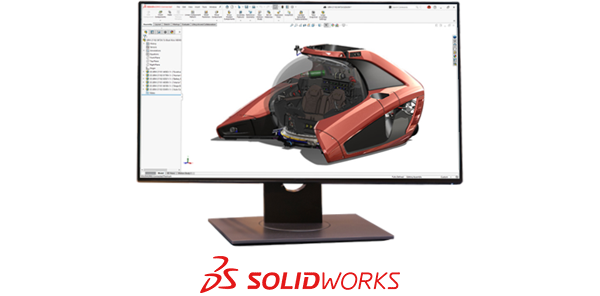
Other tools, such as SolidWorks Sustainability, don’t focus on one particular design domain, but allow modeling of a wide range of products. SolidWorks has chosen its approach specifically to meet the needs of designers and engineers who want to incorporate pre-production modeling of environmental impacts into their product development process.
Like other tools of this type, SolidWorks Sustainability uses secondary LCA data to develop a quick, robust assessment, which could be called a “screening LCA” or an LCA-based design assessment. But because it doesn’t use the company’s own primary data, SolidWorks Sustainability shouldn’t replace comprehensive LCA software, such as PE International’s GaBi software.
SolidWorks Sustainability should be used as an environmental impact dashboard, giving immediate feedback on the impact of design decisions. Although it may be considered LCA “light,” it is powered by PE International’s LCA database (confusingly also called GaBi), and uses a general process model made using the GaBi LCA software. This powerful engine provides designers with the tools appropriate for creating comparative models and making educated trade-off decisions. Its integration with SolidWorks’ 3D modeling suite enables real-time impact analysis during the design process.
In SolidWorks Sustainability, impacts are represented in several categories. It assumes that designers benefit from more granularity than a single number score can give, but that environmental impacts can easily be understood and estimated by using a small set of key environmental indicators. It currently shows four types of environmental impacts:
-
Natural resource depletion: Non-Renewable Lifecycle Energy Demand
-
Impact to the air: Air Acidification
-
Impact to water/earth: Water Eutrophication
-
Impact to the climate: Carbon Footprint
SolidWorks Sustainability has been developed to enable sustainable design in the context of product design, helping developers make informed choices about environmental impacts early enough in their life cycles to lock in benefits from the start. With tools of this type, environmental impact becomes a design decision and not a post mortem examination.
[1] See https://www.design-compass.org/
| <<< Previous: Qualitative Matrix Life Cycle Assessment | >>> Next: Life Cycle Assessment |