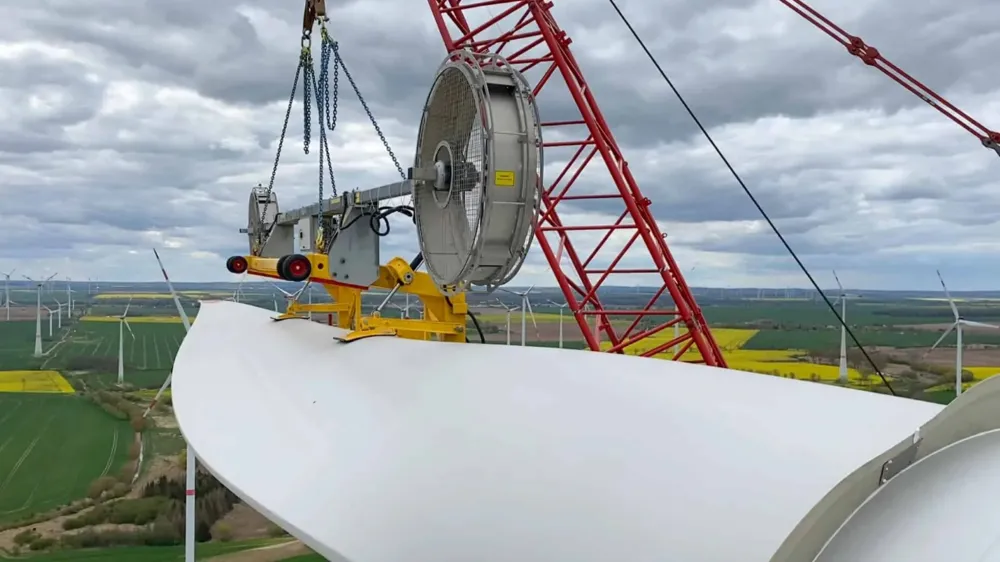
Seasight Solutions Transforms Wind Turbine Installation
Industrial machinery manufacturer accelerates product development and elevates turbine construction safety with SOLIDWORKS Design and SOLIDWORKS PDM.
Challenge
Develop a safer, more predictable load-control system capable of stabilizing massive wind turbine blades and nacelles in tight work areas and volatile wind conditions.
Solution
Use SOLIDWORKS Design to virtually model, test, and validate every motion, clearance, and subsystem before fabrication, and SOLIDWORKS PDM to control drawings and data for accuracy, access, and coordinated collaboration across the engineering team.
Results
- Minimized prototypes, rework, and design errors
- Centralized and secured all design files for fast retrieval
- Increased installation safety by eliminating manual taglines
- Reduced installation time
The use of wind energy is growing, but installing modern turbines remains a high-stakes engineering challenge. The components are bigger, the towers reach as high as a 30- to 45-story building, and weather continues to considerably limit construction. In addition, traditional tagline systems (long ropes held by crews standing far from the crane pad) demand large cleared areas, increase risk for ground personnel, and slow installation in locations where terrain, infrastructure, or local regulations limit the availability of construction space.
Seasight Solutions, a Danish technology company headquartered in Hvide Sande on the west coast of the country, has worked in heavy lifting and handling since 1950. As turbine manufacturers began asking for safer, more precise, and more predictable lifting methods, and as wind-farm sites moved closer to towns, highways, forests, and constrained terrain, it became impossible to ignore the limitations of taglines. In addition, neighbor access issues, highway closures, environmental sensitivities, and hardstand restrictions created a bottleneck for turbine erection. (A hardstand is a flat reinforced work area built at the base of a wind turbine site, essentially a heavy-duty construction pad where the crane sits, where trucks unload components, and all the heavy lifting happens.)
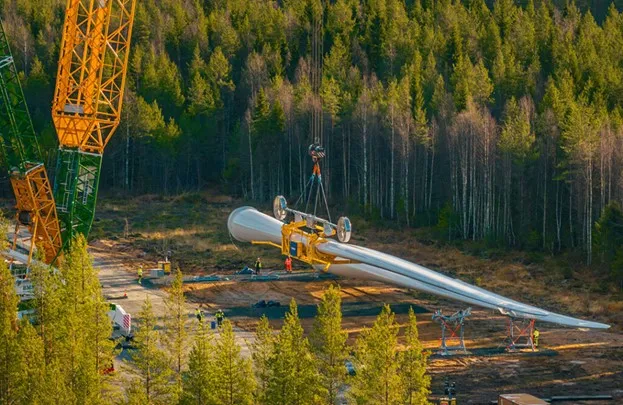
“About six years ago one of the big turbine manufacturers came to us with a challenge,” explains Seasight Head of Engineering Lasse Jørgensen. “They had a prototype for autonomous load control but needed someone to turn it into a real product. That's how the Autonomous Positioning System was born.” The engineering problem was straightforward but the inherent challenges were daunting: How do you stabilize a massive blade or nacelle in turbulent and unpredictable environmental conditions, remove ground personnel from the fall zone, and eliminate long taglines all within a tight (and often carefully regulated) work area while increasing installation efficiency and predictability? (A nacelle is the “engine room” of the turbine that sits behind the rotor hub and is one of the heaviest components lifted during turbine installation.)
Virtual Testing of Design Efficacy
Seasight responded by developing the Autonomous Positioning System (APS), a thruster-based load-control system that replaces taglines entirely. Instead of relying on rope operators standing 30 to 100 feet away, the APS controls the load directly at the hook using integrated thruster technology and real-time software. The system design includes redundancy on all major subsystems, supports sling-load configurations, and can be attached using a Quick Shift fast-mount interface that uses quick-lock brackets so the APS system can be moved, attached, or removed in minutes instead of hours. This prevents the laborious bolting and unbolting of complicated parts every time you switch from lifting a nacelle to lifting a blade.
“Today, the APS has replaced traditional taglines with thruster technology, making turbine installations safer, faster, and far less dependent on large work areas,” emphasizes Jørgensen. “It transforms how wind turbines are installed: One operator can stabilize loads that once required 20 people working in sync with taglines.”
Related Resources
We developed the entire system in SOLIDWORKS, which meant we could test the assemblies, movement, and interference virtually before production. That made our first APS system work almost from day one.
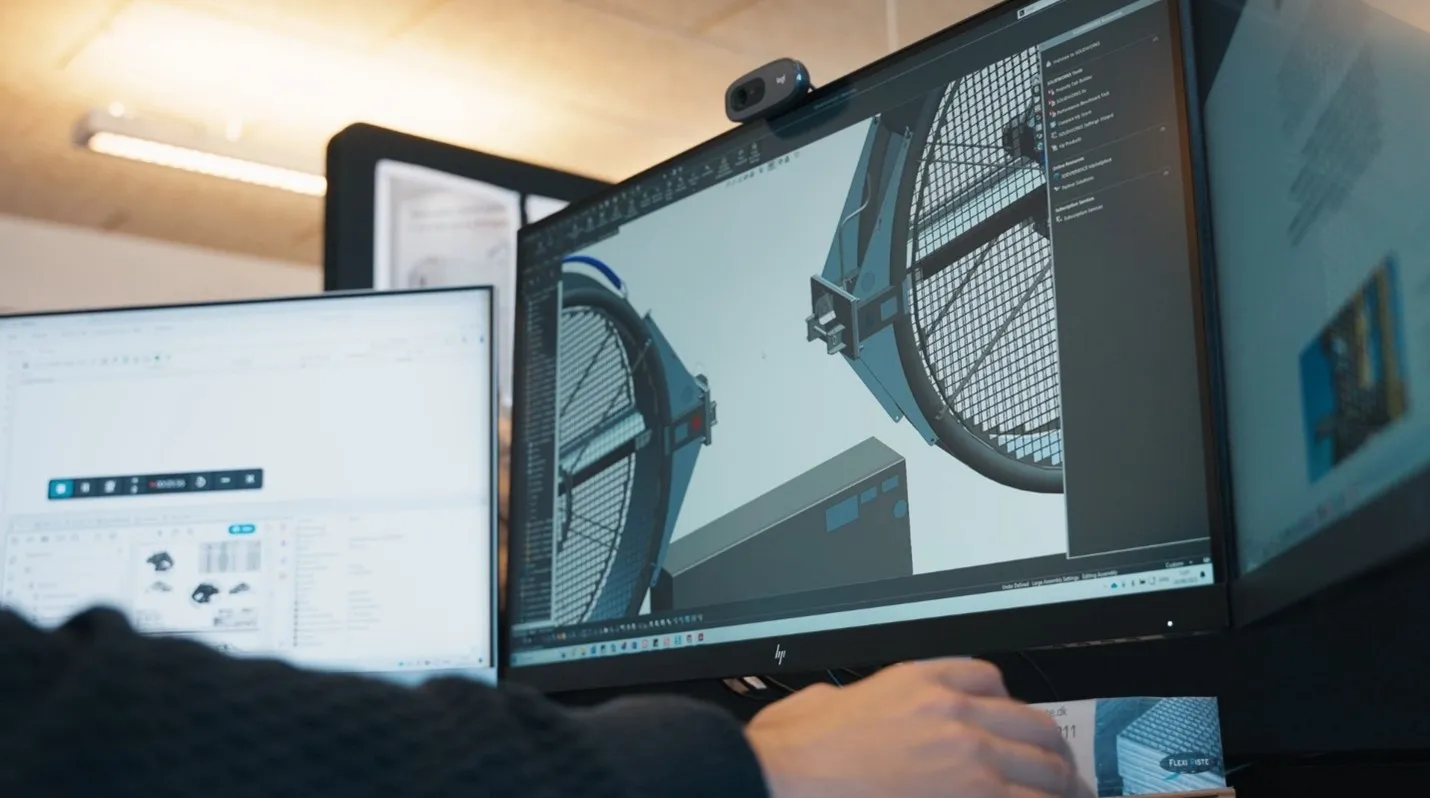
The APS is now one of Seasight Solutions flagship products, and every detail of its development happened inside SOLIDWORKS®. “We developed the entire system in SOLIDWORKS, which meant we could test the assemblies, movement, and interference virtually before production,” notes Jørgensen. “That made our first APS system work almost from day one.”
Working within SOLIDWORKS Design allowed engineers to check clearances, simulate stroke lengths in the pitch system, and verify whether small machined components and large welded assemblies would interact correctly without interference. When customers sent their 3D models of turbine parts, the Seasight engineering team could load those files directly into SOLIDWORKS Design, which enabled them to see exactly how each part, such as the blades or the nacelle, would interact with the APS and the lifting gear before anything was built or lifted.
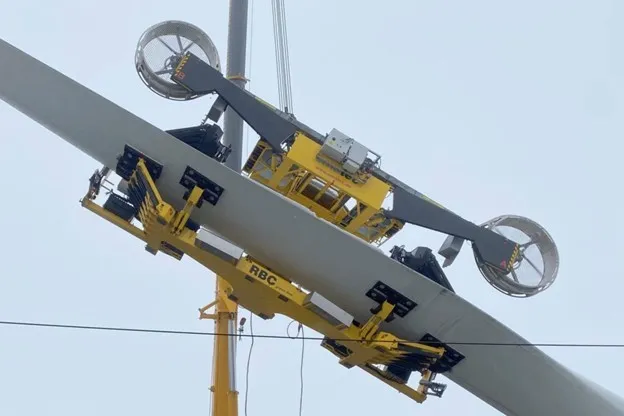
This level of virtual testing was critical. Like any day, winds are unpredictable on installation days, and each component behaves differently when suspended in air. The APS had to maintain precise control even when visibility dropped or gusts of wind pushed the load off its axis.
Design Data Control and Accessibility
Seasight standardized and managed its drawings and structured data with SOLIDWORKS PDM. As Jørgensen explains: “With SOLIDWORKS PDM we can handle all our CAD files, so 2D and 3D drawings are in one place, which makes it a lot easier for us to handle all our files, and gives us peace of mind because we have to back up our files in only one place.”
The APS team also benefited from SOLIDWORKS’ high level of usability. “It's so easy that we can almost give it to an intern who has never used 3D software and within one to two weeks we have them drawing and assembling in SOLIDWORKS,” enthuses Jørgensen.
The SOLIDWORKS digital workflow streamlined the product development process, minimized rework, reduced prototypes, and accelerated Seasight’s pace of innovation as wind-energy demands evolved.
Results Speak for Themselves
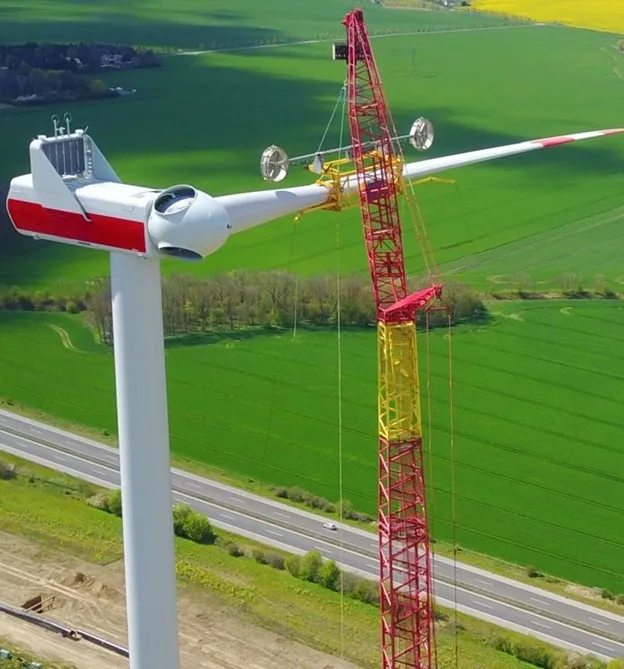
The APS has revamped turbine installation. By eliminating taglines, Seasight removed some of the industry’s most persistent safety risks, including burn and back injuries, dislocated shoulders, twisted ankles, and other hazards common when handling ropes under load. Crews now maintain full control of the load from the crane pad without personnel standing far outside the hardstand. The result is smaller required work areas and fewer environmental and permitting conflicts.
Without taglines, wind-farm planners avoid many of the delays tied to neighborhood access, restricted terrain, or highway closures. Also, the APS is not limited by the size of hardstands, which enables work in forests, mountainous regions, and other constrained settings.
By maintaining stability even in wind speeds up to 30 mph, the APS widens the operational weather window: Crews can operate in low visibility, snow, or seasonal weather conditions that would normally shut down operations. This directly addresses one of the biggest cost drivers in modern wind-energy construction. The APS also increases main-crane utilization and improves project predictability.
Engineering Matters
These results trace directly back to Seasight’s disciplined engineering process. “With SOLIDWORKS we can catch almost every problem before it enters our workshop. I would say around 99%,” Jørgensen says. “It saves us a lot of time and in the end saves us a lot of cost on our prototypes.”
Jørgensen sees digital design playing an even bigger role in the future. “With so many different machines and tools, creating full digital twins hasn't always been easy. But with AI it's becoming much more realistic to bring the tool to our CAD environment. And that opens possibility for how we design and work.”
Seasight Solutions’ APS represents the kind of practical innovation that impacts an entire industry by enabling safer lifts, smaller work areas, more predictable construction schedules, and lower total cost of installation. With SOLIDWORKS Design and SOLIDWORKS PDM underpinning the engineering workflow, Seasight Solutions brings precision, control, and new confidence, to turbine installation.
Products:
- SOLIDWORKS Design Premium
- SOLIDWORKS PDM Professional
Learn More About SOLIDWORKS Expanded Solutions
Have questions about SOLIDWORKS Solutions?
SOLIDWORKS solutions enable you and your team to quickly transform new ideas into great products.