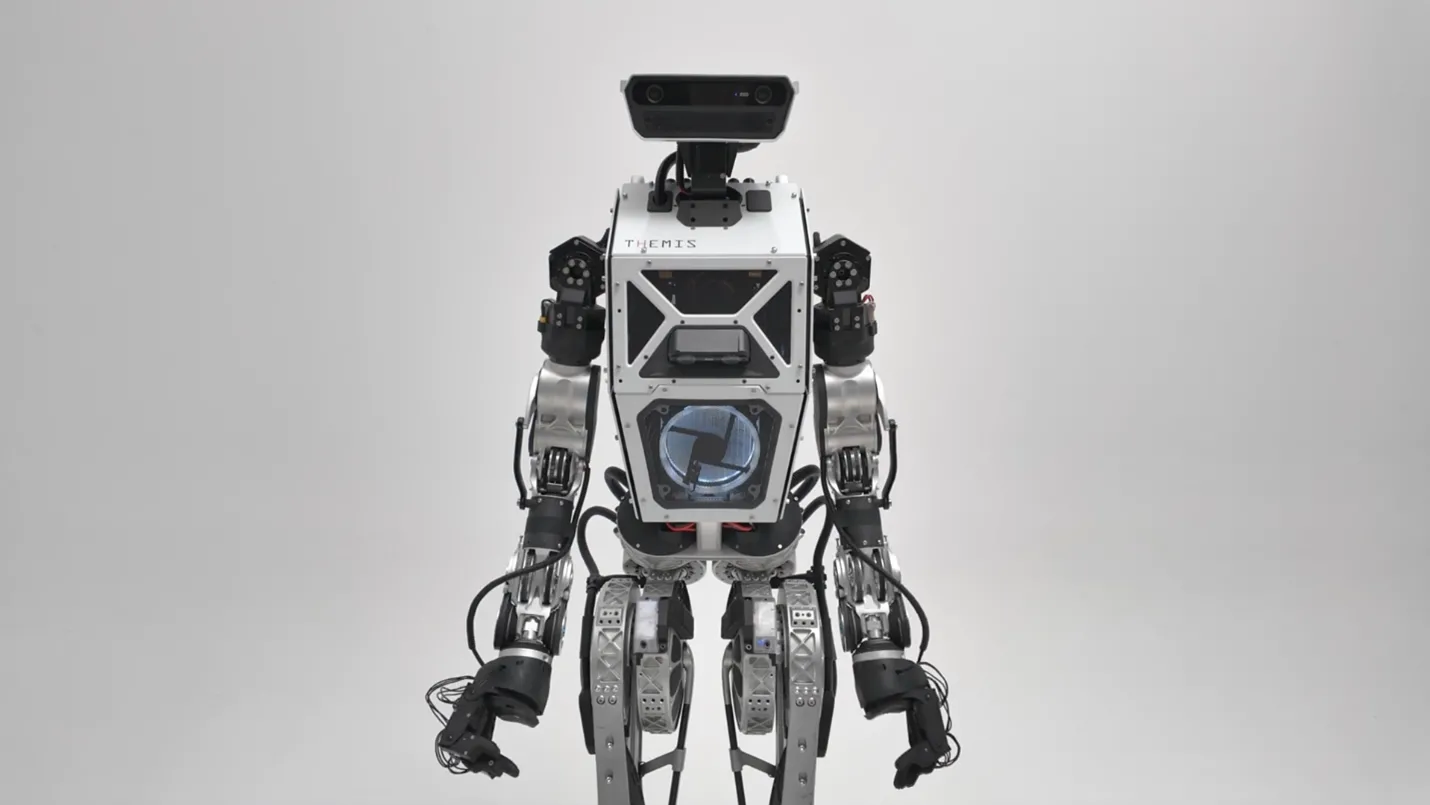
Westwood Robotics Delivers Reliable Humanoid Systems Faster
Advanced robotics company integrates design and simulation with SOLIDWORKS to validate concepts early, reduce iteration cycles, and deliver scalable humanoid robots for real-world use.
Challenge
Design humanoid robots that coordinate mechanical systems, sensing, control, and AI into a single, physically realizable platform that can maintain balance, interpret environments, and operate reliably in unpredictable conditions.
Solution
Integrated SOLIDWORKS Design for both design and simulation to maintain a tight feedback loop between design intent and real-world behavior.
Results
- Reduced iteration cycles by identifying design limitations earlier in development.
- Improved confidence in design decisions through upfront simulation validation.
- Enabled transition from conceptual designs to physically realizable, manufacturable systems.
- Supported development of scalable humanoid platforms capable of real-world interaction and dynamic motion.
The field of robotics is moving out of controlled environments and into serving aspects of everyday life, such as delivery networks and manufacturing floors and homes. As that shift accelerates, expectations change. Systems must not only work, but work reliably, accurately, and at a cost that makes real-world deployment viable.
Humanoid robots, among the most complex products being developed today, are at the center of this transition. These robots require tight coordination across mechanical design, electronics, software, and artificial intelligence (AI). Beyond just building a machine, the challenge is building one that can maintain its balance, interpret its surroundings through advanced sensing, and operate consistently in unpredictable environments. In other words, mechanical systems, sensing, control, and AI must converge into a single, physically realizable platform.
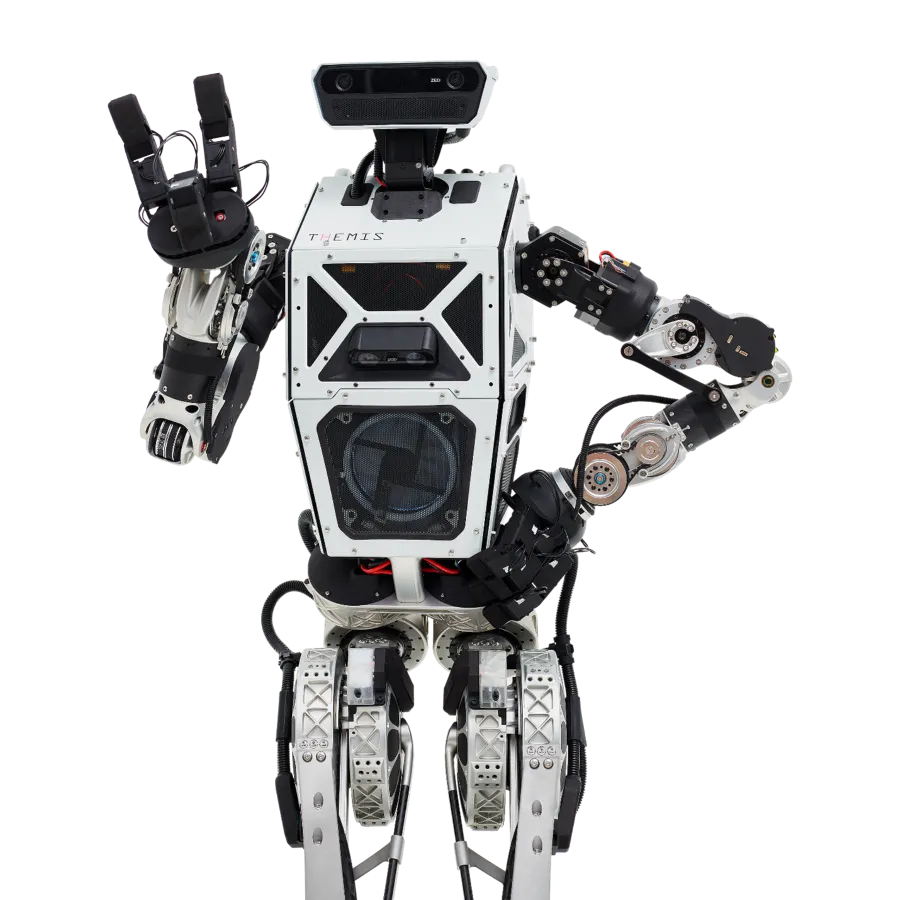
This design challenge is central to the mission of Westwood Robotics, which was founded in 2018 by previous core members of UCLA’s Robotics & Mechanisms Laboratory (RoMeLa).
As a developer of humanoid robotics and proprioceptive actuators—sensors that continuously measure position, speed, and force, and use that data to adjust their motion instantly—Westwood Robotics has developed flagship platforms such as THEMIS, a full-size, general-purpose humanoid, and BRUCE, a kid-sized, open-platform humanoid for STEAM (science, technology, engineering, arts, and mathematics) education and academic research.
Cool Concepts that Fail
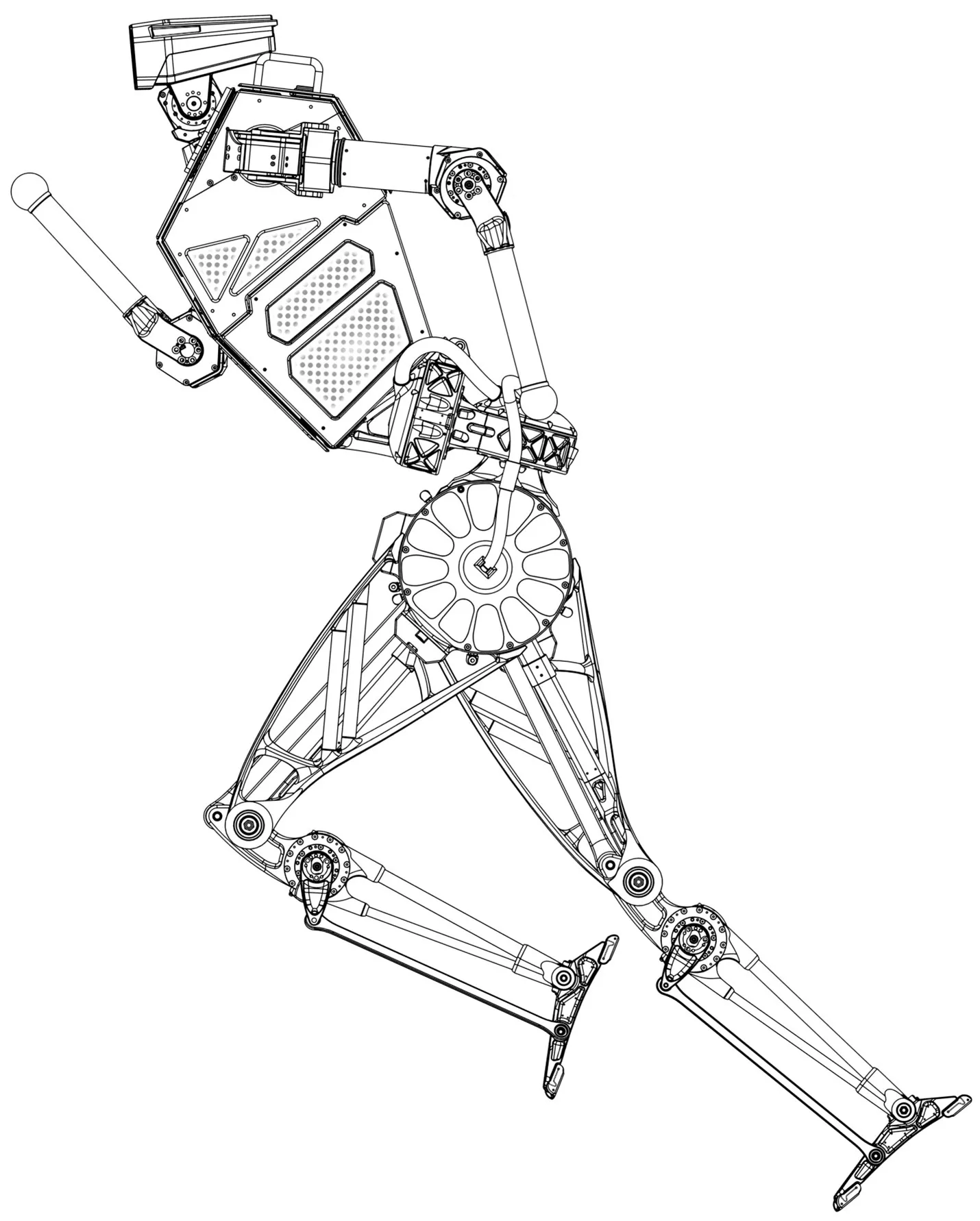
Humanoid robot development pushes the limits of design feasibility. Concepts that are elegant in theory often fail under real-world constraints such as manufacturability, cost, and structural integrity. Westwood Robotics Founder and CEO Xiaoguang Zhang explains the reality engineers face: “There are always mechanisms or designs you have in your mind that are almost impossible or too expensive to manufacture. You've got to design so it's not just manufacturable, but manufacturable in an affordable way.”
Even when designs can be built, validation can be a bottleneck.
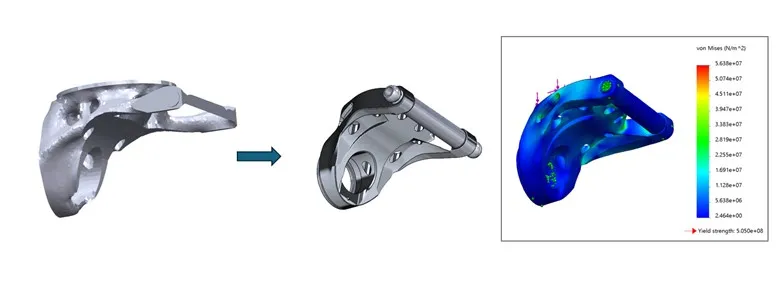
“You have a really cool design. You have those smart ideas, right? But then some of them are just impossible to be designed strong enough,” explains Zhang. “You've got to make changes to it. Sometimes you just find yourself at a dead end.” This iterative loop—design, test, fail, refine—is amplified in humanoid robotics, where balance, locomotion, and environmental interaction all must work simultaneously.
Related Resources
With SOLIDWORKS, first of all, you can realize everything. We simulate [our designs] first before we move on to anything else. Because without that validation, we are just not confident enough of making it at all
Integrated Design and Simulation
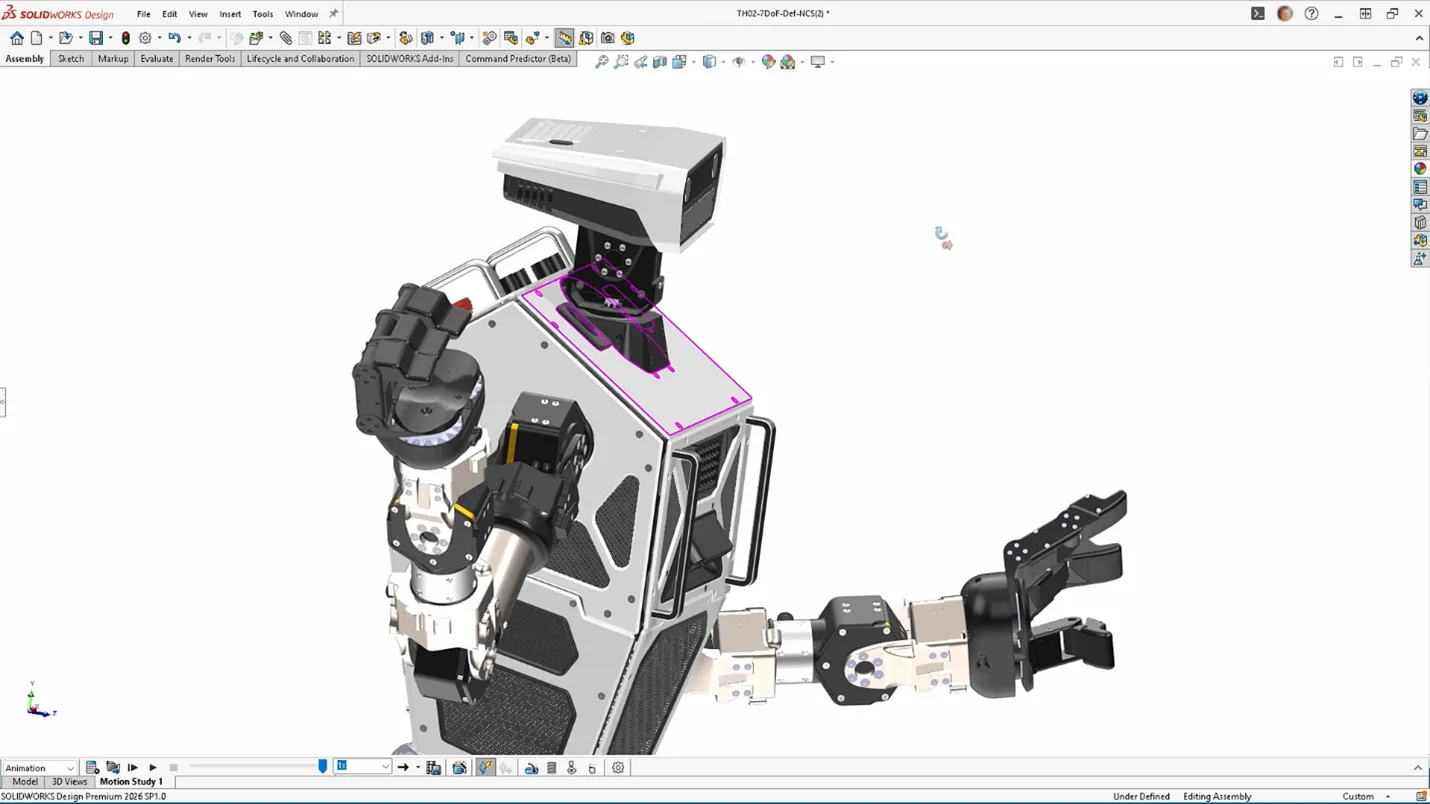
Westwood Robotics relies on SOLIDWORKS® Design to bridge the gap between conceptual design and validated engineering reality, as simulation is part of the company’s standard workflow. “With SOLIDWORKS, first of all, you can realize everything. We simulate [our designs] first before we move on to anything else. Because without that validation, we are just not confident enough of making it at all.”
This tight integration between design and simulation reflects a broader shift in robotics toward end-to-end systems that unify planning, control, and physical feasibility. SOLIDWORKS Design enables a similar philosophy at the product development level: a continuous loop between design intent and validated performance.
Westwood Robotics appreciates the smooth connection/transition between design and simulation in SOLIDWORKS Design: “It’s always the design capability of creating something in your mind into an actual part,” enthuses Zhang.
Scalable Platforms
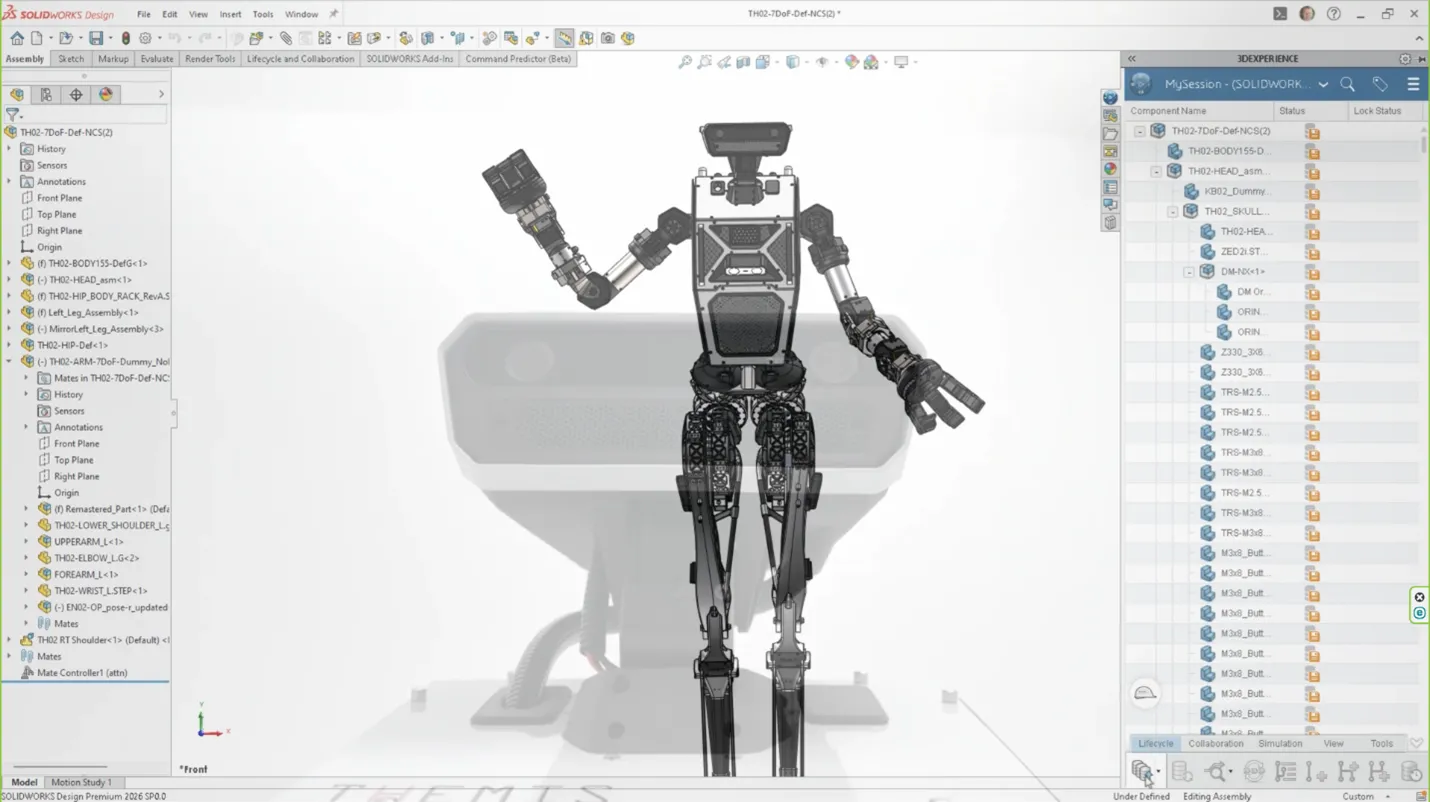
Using SOLIDWORKS Design, Westwood Robotics has developed advanced humanoid platforms such as THEMIS and BRUCE, which are designed for real-world interaction and dynamic motion. “Westwood Robotics’ THEMIS humanoid was designed for safe interaction with the environment and for dynamic motions such as walking, running, and other maneuvers.
Supporting technologies, such as high-frequency inertial sensing, provide the real-time feedback required for robotic stability and control. The outcome is not just functional prototypes, but scalable platforms for research and industrial use. Westwood Robotics’ robots demonstrate advanced locomotion, manipulation, and adaptability, all key requirements for deploying humanoid robots beyond controlled environments.
Innovation Matters
SOLIDWORKS Design is not simply a design tool, it is a core enabler of Westwood Robotics’ innovations. Zhang concludes, “What I think about SOLIDWORKS: It is one of the most important tools for generating our robot. I would panic if I woke up and realized I don’t have [SOLIDWORKS] anymore.”
By tightly integrating design and simulation, Westwood Robotics reduces iteration cycles, avoids dead-end concepts earlier, and builds confidence in every design decision. In a domain where physical feasibility and real-time performance are inseparable, that integration is the difference between ideas and working humanoid systems.
Products:
- SOLIDWORKS Professional
- SOLIDWORKS Simulation Professional
Learn More About 3DEXPERIENCE Works and SOLIDWORKS
Have questions about SOLIDWORKS Solutions?
SOLIDWORKS solutions enable you and your team to quickly transform new ideas into great products.