SOLIDWORKS Design
Discover SOLIDWORKS Design, the industry-standard 3D CAD software with cloud collaboration, secure file management, and AI-powered features.
SOLIDWORKS
Outer space hardware developer used SOLIDWORKS Design to turn a microgravity fluid experiment into a compact payload for the International Space Station.
Miniaturize a laboratory-scale microgravity fluid experiment into a compact payload capable of operating aboard the International Space Station (ISS). Manage dense mechanical integration, optical precision, thermal behavior, and launch readiness without compromising the experiment’s scientific purpose.
Use SOLIDWORKS Design to develop, iterate, and evaluate the compact payload architecture. Apply design and simulation workflows to understand layout constraints, thermal behavior, and component interactions before the hardware is operated in orbit.
Outer space hardware often requires extreme miniaturization challenges. Engineers must reduce size, mass, and excess complexity while preserving the function of an original, typically larger system. For microgravity research, such compression is especially unforgiving because an experiment must produce useful scientific data after launch, installation, activation, and operation in orbit.
Romanian InSpace Engineering, also known as RISE, was founded in Bucharest in 2017. RISE develops hardware for space and supports projects with capabilities across several disciplines including mechanical, electrical, and full-stack software development. Its DropCoal project put those capabilities to the test by turning a laboratory-scale experiment into a compact payload designed to operate aboard the International Space Station (ISS).
DropCoal is a European Space Agency–financed experiment that studies droplet behavior in microgravity, helping researchers better understand fluid motion when gravity no longer dominates how liquids collide, bounce, merge, and mix. The DropCoal payload was installed on the ICE (International Commercial Experiment) Cubes Facility, a plug-and-play research platform inside the European Space Agency’s Columbus laboratory on the ISS.
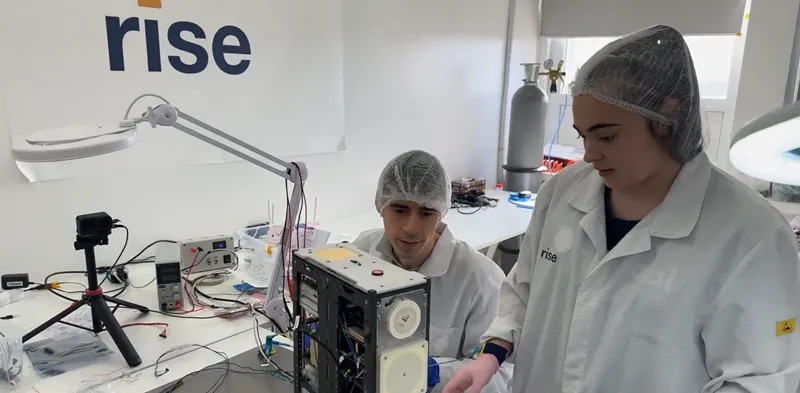
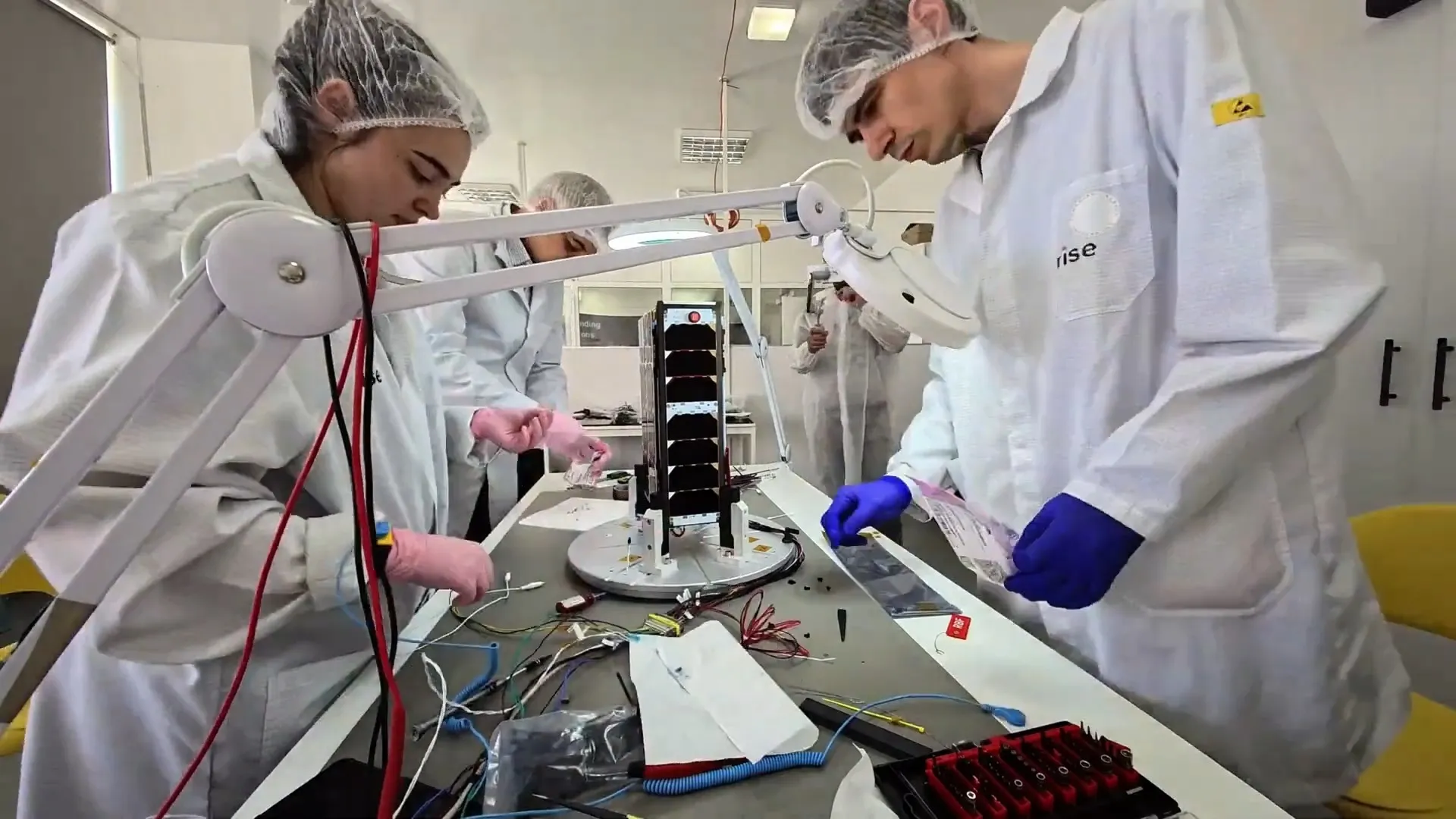
RISE Engineers working to reduce size, mass, and excess complexity to prepare their products for space.
The engineering challenge was more than building a small box. It involved compressing the function of a laboratory experiment into outer space–qualified hardware that could move droplets, control their interaction, image the results, and support analysis after the experiment ran. As Co-founder Mugurel Balan explains, RISE engineers “transform a big laboratory table into a four-liter box,” redesigning lab-scale experiments into compact payloads that can operate aboard the International Space Station.
Reducing a laboratory-scale experiment to a compact four-liter payload created significant mechanical, thermal, and packaging challenges. The system required pumps, motors to control droplet movement, optics, a high-speed camera, and onboard software for real-time image analysis. The experiment also had to capture fluid behavior at 8,000 frames per second, which made optical configuration and internal packaging central to the payload architecture.
Balan described RISE as “tiny system integrators,” a phrase well befitting the work. However, tiny did not equate with simple. The team had to fit scientific, mechanical, optical, thermal, electronic, and software requirements into an incredibly constrained box. “It was indeed really crowded,” Balan emphasized. He also added that the team had to design telecentric lenses specific to the optics.
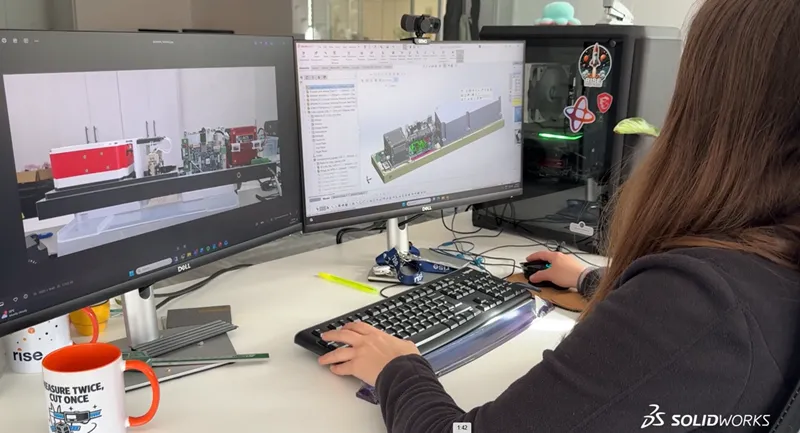
RISE engineers designing every part for weight and size consideration
Discover SOLIDWORKS Design, the industry-standard 3D CAD software with cloud collaboration, secure file management, and AI-powered features.
SOLIDWORKS
Make better design decisions with high-performance structural finite element analysis (FEA) software
SOLIDWORKS
Can advanced cloud-enabled simulation save the day from the zombie horde?
SOLIDWORKS
The results on the station were very similar with what we simulated
RISE used SOLIDWORKS® Design to convert the experiment’s scientific requirements into compact, manufacturable hardware. The practical work centered on integration: fitting mechanical, electrical, and experimental components into a tightly constrained four-liter payload while refining the design for launch, installation, and operation.
The most challenging area was thermal behavior. The payload did not operate as a simple steady-state system. It changed as components, including the light source, the camera, and the microcontroller, switched on. That sequence was significant because each step contributed to the total temperature rise in the reaction chamber.
The team used SOLIDWORKS Simulation tools throughout its iterative design process. Balan described the workflow as “design, simulate, design, simulate,” using known convection parameters to evaluate thermal behavior inside the payload. Each simulation cycle helped the team check how the compact system would behave as it was activated in stages and refine the design before launch.
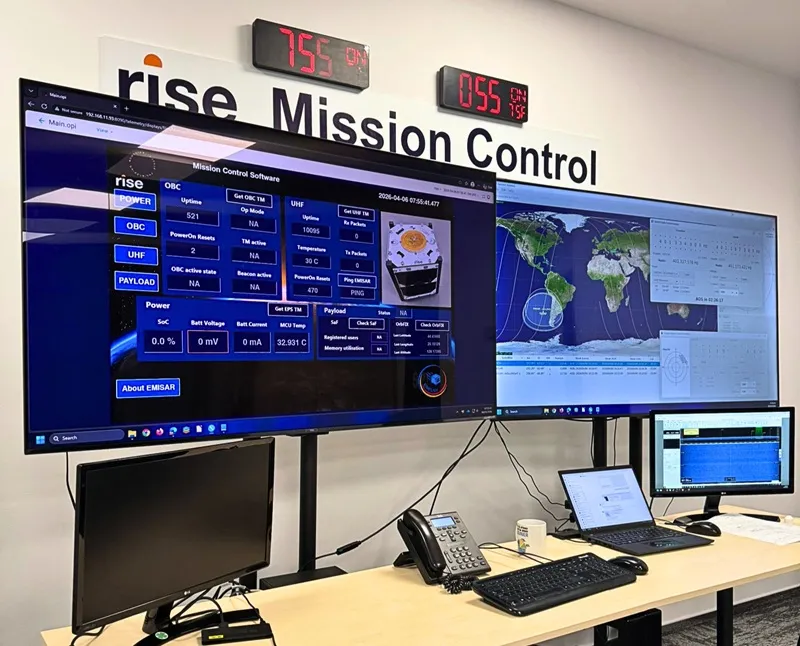
Romanian In-Space Engineering - Mission Control
The strongest outcome was the relationship between predicted behavior (using SOLIDWORKS Design simulation tools) and real operation. “The results on the station were very similar with what we simulated,” Balan noted. The alignment showed that the team’s design and simulation work had helped anticipate the compact payload’s actual system behavior while operating in orbit.
DropCoal also demonstrated that a Romanian industrial team from a company of just 50 people could develop a complete space system for International Space Station research. NASA astronaut Don Pettit installed the DropCoal experiment in the ICE Cubes Facility inside the Columbus module of the ISS. The research may help scientists better understand droplet behavior in microgravity, with potential relevance for areas such as medicine formulation, fluid delivery, and combustion modeling.
Engineers leveraged SOLIDWORKS Design to transform this scientific experiment into compact hardware that could be packaged, evaluated, launched, installed, and operated. For RISE, the repeatable engineering value is leveraging design and simulation together to reduce uncertainty before hardware reaches an environment where redesign is no longer practical.
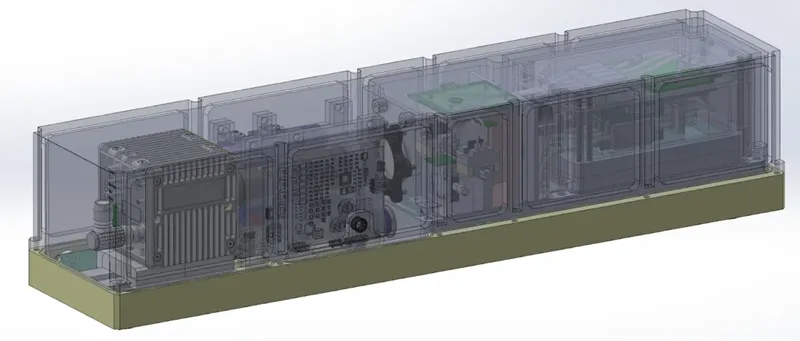
RISE DropCoal Design in SOLIDWORKS Design
DropCoal is a small payload with a large lesson for space engineering. Integration quality matters greatly in orbit, because every internal decision can affect thermal behavior, imaging quality, mechanical fit, or experimental reliability. Balan enthusiastically noted that the value of SOLIDWORKS Design came from the ability to quickly repeat the iterative MODSIM (modeling + simulation) process to understand system behavior.
For space-hardware teams, the lesson is clear: The future of orbital research will depend not only on bold mission ideas, but on the ability to compress, validate, and execute those ideas inside unforgiving physical constraints.
Innovate faster, design better & grow your career with SOLIDWORKS. Choose the industry standard 3D CAD solution trusted by professionals worldwide.
SOLIDWORKS
Discover collaborative design, its benefits, and tools to boost teamwork. Learn how SOLIDWORKS empowers innovation with seamless design collaboration.
SOLIDWORKS
Discover advancements in AI CAD tools and their impact on AI product design and how this delivers real-world outcomes for SOLIDWORKS designers.
SOLIDWORKS
SOLIDWORKS solutions enable you and your team to quickly transform new ideas into great products.